

Home / Blog / Founder Lessons
Dubai As A Launchpad · A 3-Part Series For Women Founders · Part 1 of 3
Why Dubai Is the Gulf's Launchpad — and the Funding Numbers Nobody Shows You
Dubai will get you in the room. It won't close Riyadh, Doha, or Muscat for you. Part 1 of this series makes the honest case for the city — and shows you the capital math every woman founder should see before planning a GCC expansion.
Riddhi Roy | Founder – Brandverse
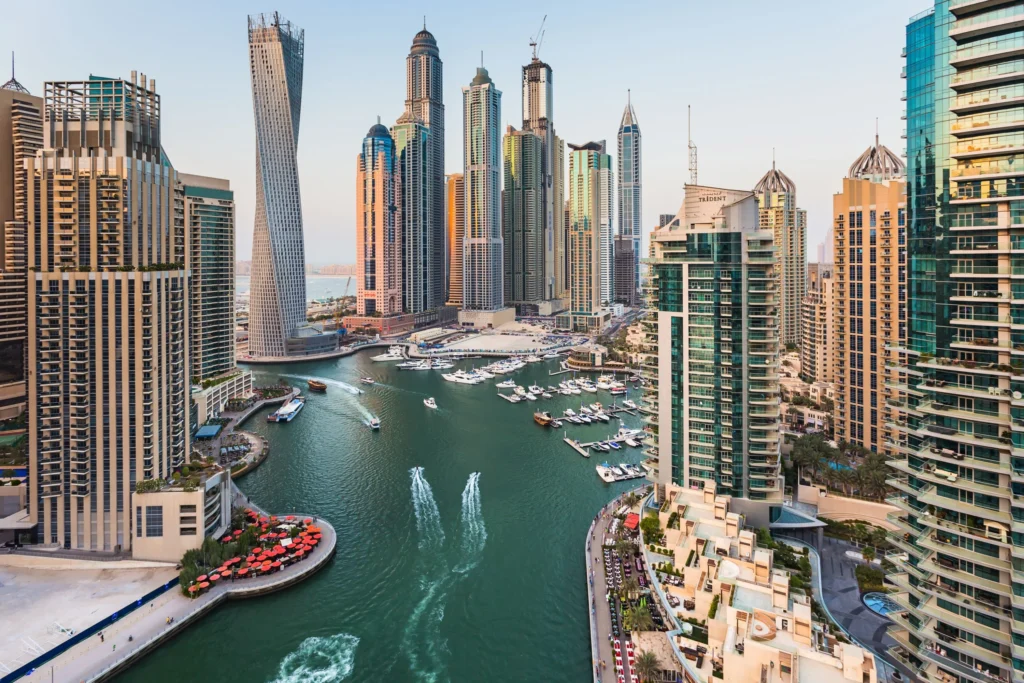
There’s a moment most women founders in Dubai will easily recognize – the business is finally working. Revenue is steady, the team has found its rhythm, and then someone — an investor, a customer, a well-meaning mentor at a DIFC networking evening — leans in and says the sentence: “So, when are you launching in Saudi?”
It sounds like a compliment. However, it’s actually a kind of trap door, and how you answer determines whether you fall through it. Because the single most expensive assumption a Gulf founder can make is that the GCC is one market with six flags. It isn’t. It’s six distinct regulatory regimes – six consumer cultures, six hiring realities, and six very different relationships with women in business – connected, conveniently, by a two-hour flight radius from Dubai International.
Dubai deserves its reputation as the region’s launchpad. But a launchpad is exactly that: the place you leave from, not the destination. This series is about the gap in between — what you genuinely need in place before you expand, told straight, with the numbers that usually get left out of the LinkedIn version.
The Case For Dubai
Why Dubai earned the launchpad title
Women now represent roughly 18% of all entrepreneurs in the UAE, and nearly 80% of those businesses are led by founders under 40 — a demographic profile most Western ecosystems would envy. The 100% foreign ownership reforms mean a woman can hold full legal control of her company and its capital without a local intermediary. Zero personal income tax means what you earn compounds into what you build.
The capital picture backs it up. The UAE attracted over $3.5 billion in venture investment in 2026 according to MAGNiTT data — the largest recipient of startup funding in MENA for the fourth consecutive year — and consistently leads the region on deal count. The cost of entry is genuinely low too: the DIFC Innovation Hub offers subsidised innovation licences starting around USD 1,500 a year for qualifying tech startups, with common-law courts and full capital repatriation built in. Programmes like the Dubai Business Women Council’s sAIdaty initiative (built with Oracle) are training women founders specifically in AI and cloud, and listed companies are legally required to have women on their boards. This isn’t PR gloss; it’s structural.


18%
of all UAE entrepreneurs are women — ~80% under 40
$3.5B+
VC attracted by the UAE in 2026 (MAGNiTT)
100%
foreign ownership in free zones & most mainland activities
2 hrs
average flight from Dubai to every GCC capital
But know which bubble you're standing in
Here’s the caveat that deserves its own name: the demographic bubble. Dubai’s consumer base is roughly 90% expatriate — a dense, multicultural, digitally fluent test market that is brilliant for validating international appeal. But a product that wins in Dubai has proven it works on global customers, not necessarily on Gulf customers. Saudi Arabia’s market is the mirror opposite: overwhelmingly national, Arabic-first, with its own buying psychology and channel dynamics. Treat your Dubai traction as proof of concept, not proof of region — and treat the corporate structure you built in a free zone as a foundation to build on, not a finished blueprint.
And here’s the strategic reason Dubai matters for expansion specifically: the Gulf’s venture money has become intensely concentrated. In Q1 2025, Saudi Arabia and the UAE together accounted for 88% of MENA’s deal value. By the end of 2025, Saudi Arabia alone contributed 45% of all regional VC funding, raising $1.72 billion — more than double its previous year. If your growth story needs regional capital, you are, whether you like it or not, playing a two-country game with four supporting markets.
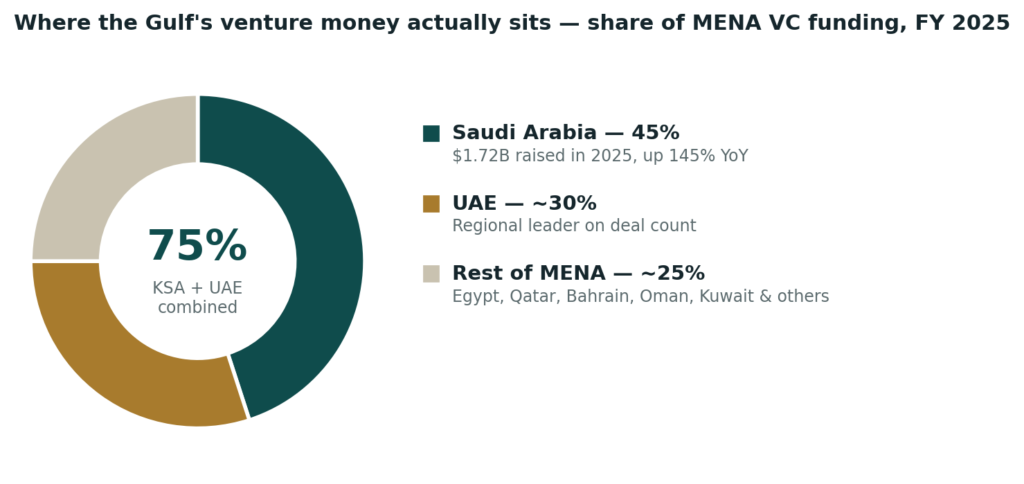
Sources: MAGNiTT FY2025 venture reports; Arab News; Fintech News Middle East. In Q1 2025 alone, KSA + UAE captured 88% of MENA deal value.
The Honest Numbers
What nobody puts on the conference slide
Now the part that matters more as a woman raising money to fund that expansion is that in 2024, startups founded exclusively by women received just 1.2% of MENA’s venture funding — and painful as that figure is, it was actually a recovery, up from 0.47% in 2023, per Wamda data. In a survey of 125 female founders across the region, 58% said they believed MENA investors were less likely to back women-led startups than global investors were.
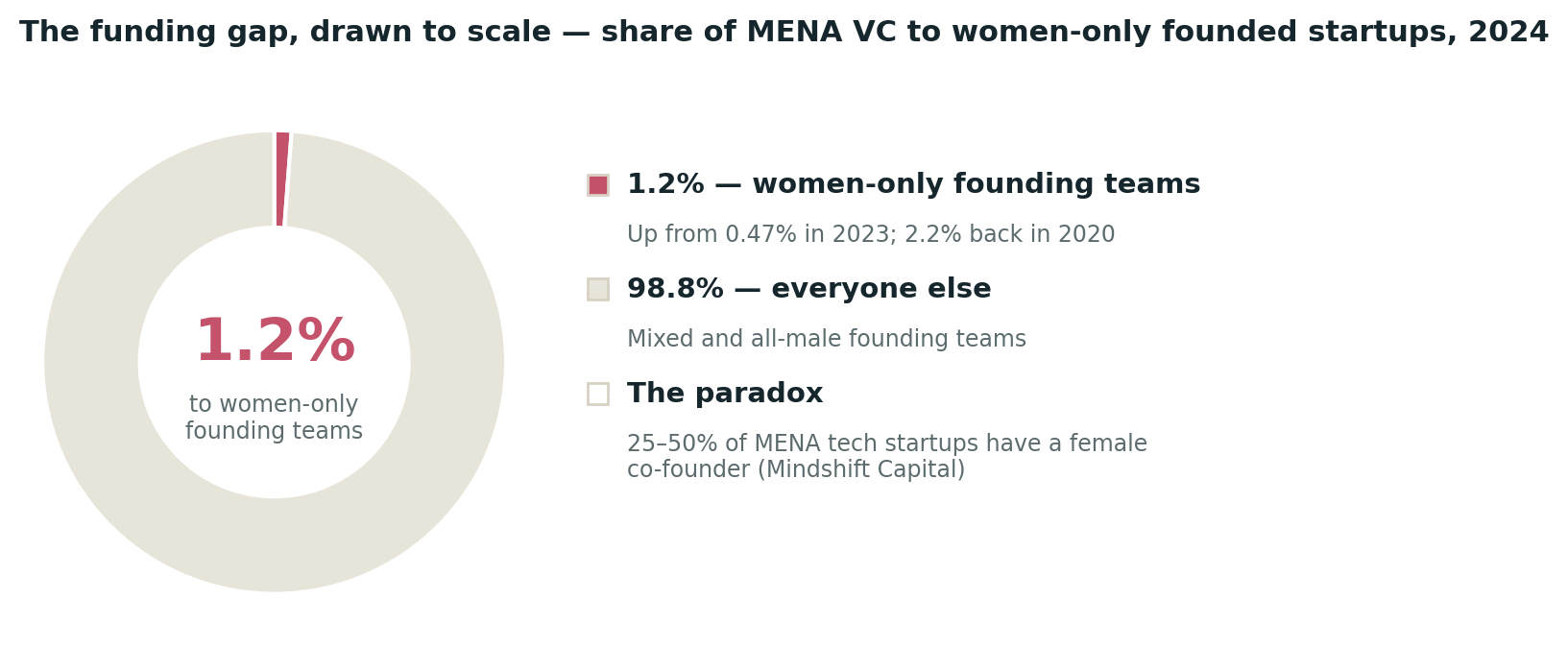
Sources: Wamda Capital data via AGBI; Mindshift Capital. August 2025 hinted at a shift — two deals alone put $72.3M into female-led ventures in a single month, led by Gathern’s $72M PIF-backed round.
There’s a reason to this analysis as it changes the math. If regional capital is harder for you to access, your GCC expansion needs to be more capital-efficient and better sequenced than your male competitors’ — not out of fairness, but out of arithmetic. The good news is that efficiency happens to be a documented strength: BCG research found women-founded companies generate 78 cents of revenue for every dollar of investment, against 31 cents for male-founded ones.
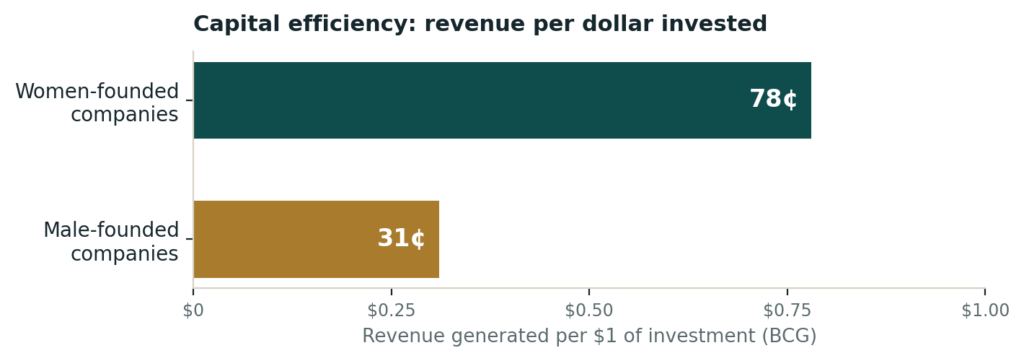
Source: Boston Consulting Group. Related research puts women-founded startups’ returns at roughly 2.5x those of male-founded peers.
The pitch isn’t “back me because I’m a woman founder.” The pitch is “I turn a dollar into more revenue than the median founder in your portfolio — and here’s my expansion plan proving it.”
The Reframe That Wins Rooms in Riyadh and DIFC Alike
And know that the money itself changes shape at the border
One more thing your Dubai fundraising experience won’t prepare you for: the type of capital changes when you cross into onshore markets. Dubai’s funding scene runs on familiar rails — private VC funds, angel networks, international accelerators. Saudi Arabia’s runs increasingly through state-backed architecture: Saudi Venture Capital (SVC), Monsha’at programmes, sovereign-linked vehicles, large family offices and corporate venture arms — networks that source deals through long-standing relationships and closed pipelines. That structure disadvantages any outsider, and women founders without inherited network access most of all. The workaround isn’t to pitch harder into closed rooms; it’s to enter through validation bridges — gender-lens investors like Mindshift Capital, angel groups like the Women’s Angel Investor Network (WAIN), and accelerator programmes whose alumni get systematically introduced to vetted syndicates and CVCs.
Coming up in Part 2: the GCC is not one market — a country-by-country field guide to Saudi Arabia, Qatar, Bahrain, Oman and Kuwait, including the licensing authorities, hiring rules and cultural realities that make each one a different game. Plus: the seven-step failure sequence that sinks most first-time expanders.