


Home / Blog / Founder Lessons
Dubai As A Launchpad · A 3-Part Series For Women Founders · Part 2 of 3
The GCC Is Not One Market: A Country-by-Country Field Guide
Six flags, six rulebooks. Part 2 maps what actually changes when you cross each border — licensing authorities, hiring quotas, consumer psychology — and the seven-step failure sequence that catches founders who treat Riyadh as "Dubai with more traffic."
Riddhi Roy | Founder – Brandverse
Previously in Part 1: why Dubai earned its launchpad title, the demographic bubble that flatters your traction, and the funding math — women-only teams raised just 1.2% of MENA VC in 2024, yet generate 78¢ of revenue per invested dollar versus 31¢ for male-founded firms.
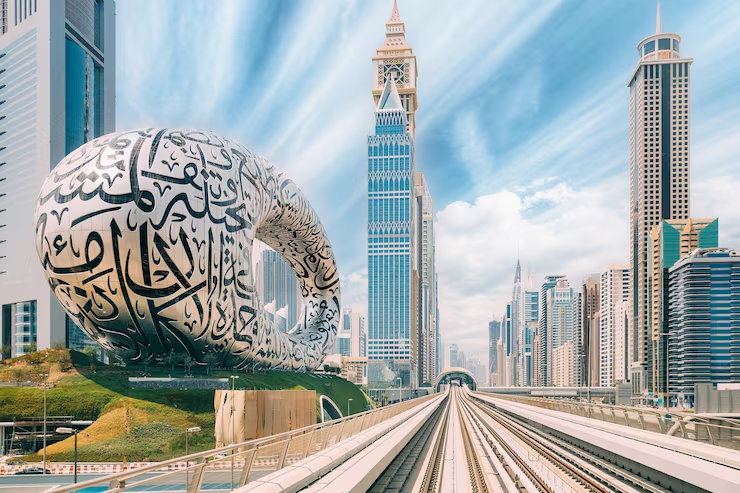
The founders who stumble hardest are the ones who treat Riyadh as “Dubai with more traffic.” Each GCC market has its own licensing authority, its own labour rules, its own consumer psychology. What resonates in Dubai’s 90%-expat market can land flat in Saudi Arabia’s overwhelmingly national one. Here’s the fast orientation:
KSA
Saudi Arabia
Sector strengths: Digital economy · Fintech · Tourism · Education
- Largest economy in MENA; the volume prize. Entry runs through a MISA (Ministry of Investment) licence — the Entrepreneur License track expects proof of innovation and VC backing, notarised corporate history and Arabic legal translations.
- Saudization (Nitaqat) is monitored live through the Qiwa platform, which grades companies from Platinum down to Red — and a Saudi hire only counts at full weight if paid at least SAR 4,000/month. Model this into your P&L before entry, not after.
- Arabic isn’t optional here. Marketing, contracts, government relations: bilingual or bust.
- Momentum for women is real: 23.2% of Saudi women now participate in startup activity, and 78% say they’re considering starting a business (Mastercard).


QAT
Qatar
Sector strengths: Sports · Infrastructure · Professional services
- Register via the Ministry of Commerce and Industry, or through the Qatar Financial Centre — which runs on English common law, a genuine comfort for foreign founders.
- Post-World Cup diversification means active government appetite for tech, sports, logistics and events ventures.
- Small, wealthy market: high revenue per customer, limited volume. Great second market, rarely a first.

BHR
Bahrain
Sector strengths: Fintech · Banking · Startups
- The region’s quiet fintech lab — early on open banking, crypto frameworks and regulatory sandboxes.
- Lower setup and operating costs than the UAE or KSA; often used as a testing ground before a Saudi push (Riyadh is a causeway drive away).

- Regulatory sandboxes let startups experiment under supervision — useful for fintech and healthtech pilots.
- Logistics and tourism are national priorities; relationship-led business culture rewards patience.
OMN
Oman
Sector strengths: Tourism · Logistics · SMEs
KWT
Kuwait
Sector strengths: Finance · Retail · Healthcare
- High disposable income and one of the Gulf’s most enthusiastic e-commerce and F&B consumer bases.
- Bureaucracy moves slower than the UAE’s; many founders serve Kuwait remotely from Dubai before committing to an entity.
UAE
UAE (your base)
Sector strengths: Tech · Luxury & retail · Healthcare
- High disposable income and one of the Gulf’s most enthusiastic e-commerce and F&B consumer bases.
- Bureaucracy moves slower than the UAE’s; many founders serve Kuwait remotely from Dubai before committing to an entity.
- Keep your HQ, IP holding structure and banking anchored here — investors like the legal familiarity of ADGM/DIFC vehicles.
- Use Dubai’s multicultural population as a built-in test lab: you can trial messaging across Arab, South Asian and Western segments in one city.
One more structural note founders often miss: alignment sells. In Saudi Arabia, a market entry story that credibly plugs into Vision 2030 priorities gets meetings — and media — that a purely commercial pitch does not. The same goes for Qatar’s National Vision 2030 and the UAE’s D33 agenda. Do the homework of mapping your product to the national plan of each market you enter. It sounds like theatre; it functions like a key.
Learn From the Wreckage
The failure sequence, mapped
The seven most common mistakes first-time GCC expanders make — each one feeds the next:
- Assuming Dubai = the GCC — the demographic bubble strikes
- Copy-pasting marketing across countries — same campaign, six audiences
- Ignoring cultural and language nuances — English-only in Riyadh
- Hiring too fast, without local rules in view — Nitaqat surprises the P&L
- Expanding before home-market systems mature — weaknesses scale too
- Underestimating relationship-building time — trust has a lead time
- Expecting overnight profitability — runway runs out mid-launch
Every step in this chain is avoidable — which is exactly what Part 3 is for.
Coming up in Part 3: the pre-expansion playbook — a nine-point readiness checklist (entity structure, tax traps, Arabic localisation, runway math), the funds and programmes that actually back women founders, and a realistic month-by-month launch timeline.